
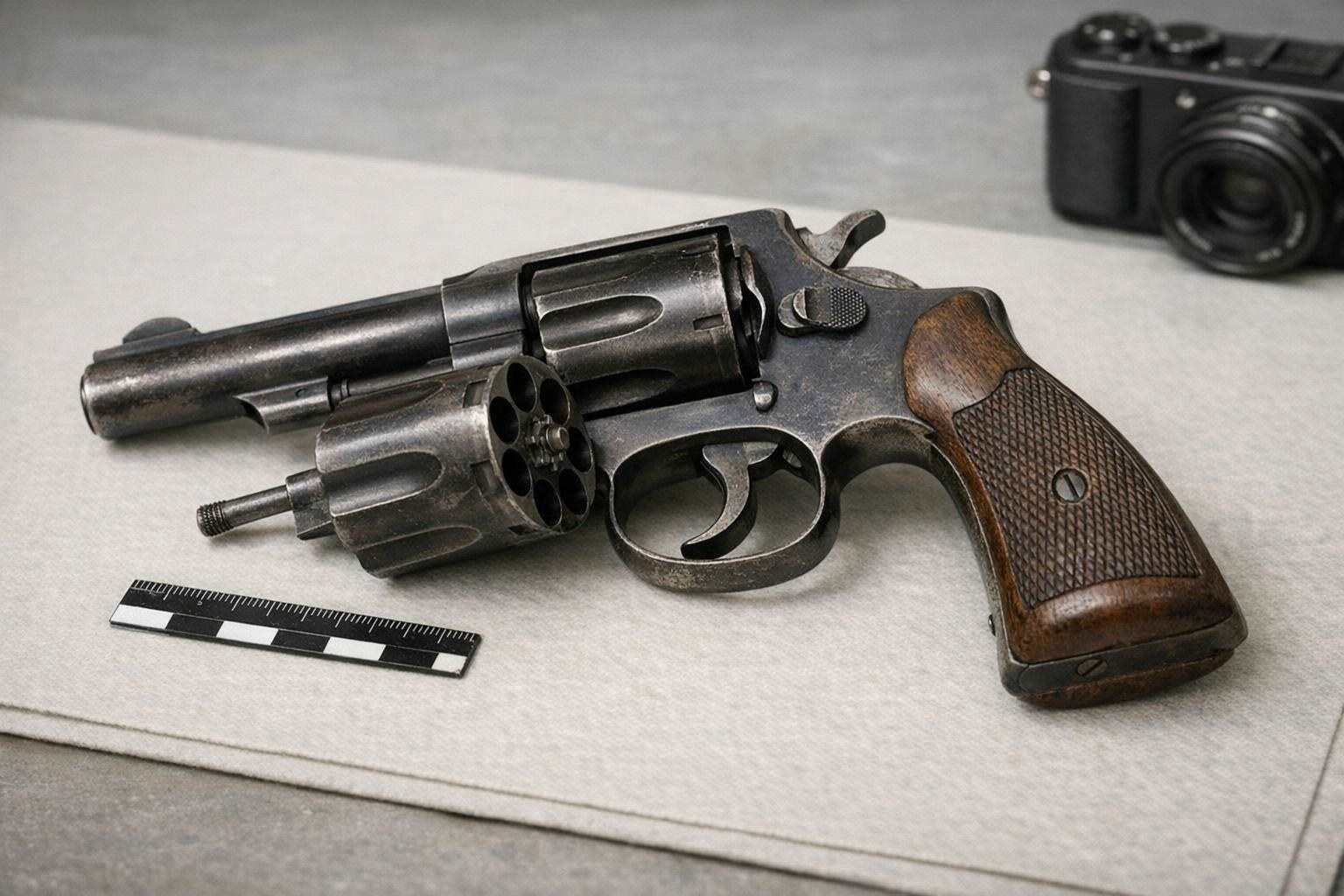
A small amount of wear can greatly affect the value of a collectible, and a gun's finish can look very different depending on how you photograph it. In general, it is wise to err on the side of caution when documenting a firearm for sale. The goal of documentation is to create a clear and accurate history of a gun's past, not to try to make a gun look like it is in better condition than it really is.
While documenting a collectible handgun for sale prior to lock can entail discussion of the mechanical design, historical period details, and specific past usage, four key approaches must be modified in order to maintain accurate documentation. Firstly, the documentation of a handgun's condition must be recorded as evidence, and treated with the same careful reserve as would be the reporting of physical and/or medical evidence in a court of law.
The first change: condition becomes a record, not a verdict
Words like excellent, original, and untouched hide within them a multitude of interpretations. Finishing loss, scratches, dents, and wear can all be noted as they are found. Is there edge wear? Are the grips in good condition? Are all of the markings clearly legible? Are there any signs of small part disassembly (screws, etc.)? Describe the location of each noted condition on the firearm and whether or not it can be viewed from multiple angles.
Important: uniform color does not necessarily mean that a firearm has an original finish and scattered wear does not necessarily mean that a firearm has never been refinished. Use qualified language when documenting incomplete evidence, for example: "appears consistent with age and handling" rather than "original".
Wait until you have recorded all observations before moving the item under consideration. A feature which has been unclear may develop into an observable characteristic while the object is being moved for another observation. Do not rub, polish, or otherwise attempt to clean an indistinct characteristic in an attempt to make it more obvious. Instead record it as unclear.
The second change: firearm photography becomes controlled comparison
Photos of a firearm should enable comparison with later photos. Take photos of the firearm in a straightforward background and use mildly diffused light. Very reflective surfaces can conceal shallow scratches while very directional lighting can make minor scratches look much worse than they really are. Many angles of lighting are better than one very dramatic photo.
Many elements of a firearm should be photographed, including both sides of the firearm, top and bottom if appropriate, the muzzle, cylinder, crane, grips, and all visible markings. Views showing unusual wear, finish breaks, etc. should also be photographed. These views should be taken looking straight at the surface of the firearm (identification views) and then at a slightly angle to show texture. Do not use filters, automatically enhance, or edit in any way to change color or hide flaws.
A scale reference can be included in photos for purposes of identification. The reference must not touch the firearm and should be placed beside it. All copies of the photographs, whether resized or re-exported, must be stored along with a record of the date they were taken, the device used to take them and any changes to the lighting that could affect the color of the photographs.
Always treat all firearms with extreme care before taking pictures or handling them in any way. Always point the muzzle of a firearm in a safe direction, keep the action open, keep ammunition away from work area and always verify that the firearm is completely unloaded before referring to it as unloaded. Refer to the current manufacturer's guidelines for verifying a firearm is unloaded. If you are in doubt as to the firearm's condition, seek assistance from a qualified expert.
The third change: cleaning is separated from preservation
Also, remember that documentation can precede cleaning. There may be dust or other debris on the surface of an object under study and this must not be wiped away before photographs have been taken of all sides of the object, for the debris may leave a residue on the surface after wiping and this in turn provide evidence of prior handling.
Compounds, such as metal polish, which use abrasives, should not be used to clean or preserve firearms. They can round sharp edges, alter the finish and remove original surface material. Such treatments will result in the firearm having an 'altered' surface. The original finish of a firearm is best left as it is, i.e. in its original, 'as found' condition.
When recording signs of wear such as corrosion, damaged grips or parts that are stuck, it is best to treat these as separate issues from preservation and record them first. It is best to get a qualified professional to deal with these as soon as possible and record any subsequent work or conservation as a later event.
The fourth change: markings are treated as evidence
When recording a firearm's serial number, manufacturer's name, caliber, etc. try to record everything that you can see. If in doubt as to a worn letter then record it as it is and not as you think it should be. Include a close up photo of any marking on the firearm and also a wider view of the whole area to show the location of the marking and also if the surrounding area has been affected in any way.
Additional details that might be of use to a historian are the shape of the front sight, the style of the grips, the form of the hammer and trigger, the configuration of the ejector rods, and any internal components or visible assembly details. These would be best recorded in a descriptive form and not used as proof of date or model.
Don't take the firearm apart to take better photos of internal parts. Such actions can introduce new marks to the firearm surfaces and parts can be lost. Also, as the item is being disassembled for photos the condition of the firearm is changed and these items must be preserved for future reference by others.
The fifth change: provenance moves from story to support
Proof of a firearm's provenance is strongest when linked to dated, independent proof such as sales receipts, inherited papers, gun shop catalogs, letters, previously made photographs and appraisals. Each document should be described as to what it actually proves. A family story, gun shop literature or handwritten note proves nothing unless proven by further, independent proof. Such information only becomes useful as proven fact.
Different things from the same material. A family story or a dealer's description of a handgun's history, even handwritten notes by a collector, are valuable for establishing a context for a handgun's history. They must, however, be clearly distinguished from provenance that has actually been verified with evidence. This material should not be used to create a more complete history than actually exists.
Additionally, the legal requirements for transferring, storing and documenting guns in various jurisdictions can change frequently. A collector should maintain his or her files in accordance with the current laws and consult with appropriate authorities as needed.
The sixth change: the archive becomes part of the object
Create a simple document to store the information for each gun. A simple format to record information would be to write an identification description of the gun and then record the date you observed it. Next would be to copy and paste all of your condition notes for that gun and then add all of the pictures for that gun. Finally add a short handling history for that gun. It is also very important to add later changes as separate entries and not edit or delete previous entries.
Be sure to use a consistent file name when saving your files, and save a second copy in a different location. This will ensure that in case your files are lost or accidentally deleted that you will have a second copy. Print out your notes, too, in case your digital files are moved in some way and you can't find them.
In this simple way, the historical evidence of a pre-lock handgun is left intact for future inspection by the collector and others. It is important to remember that a clean object does not necessarily mean an original object. Also, a clean object does not necessarily mean a good object.